Tuesday, July 20, 2010

Week 7: Spiders and Pandas and Elephants, Oh My!


After three years with the Insect Zoo, this week I finally held a tarantula. Tarantulas aren’t handled very much; it’s not really good for them and there isn’t often a need to hold them, so they are usually left alone. However, this week I was making one of my instructional videos for volunteers, “What to do if a tarantula escapes.”

Before the museum opened one morning, my boss got out one of our tarantulas and demonstrated, for the cameras, what to do if she escaped. He placed her on the carpet and then scooped her into a deli cup. After the demonstration, I was able to pet her and then hold her. Tarantulas really aren’t that scary. She was very docile and soft and perfectly content to just sit still on my hand.

I was also finally able to go on an interns’ tour of MSC, the Museum Support Center. This complex in Maryland is where many of the Natural History Museum’s specimens are stored. There, a series of climate-controlled pods hold everything from fossils to Samurai suits to boats.

On this tour, we saw some of the Anthropology and Mammal Collections. In the Anthropology collection we saw 1,500-year-old Peruvian cloth, an amazing Japanese doll house, parkas made of whale intestines and more. I was even able to hold a one million-year-old hand axe from Kenya, donated to the museum by the Leakeys.

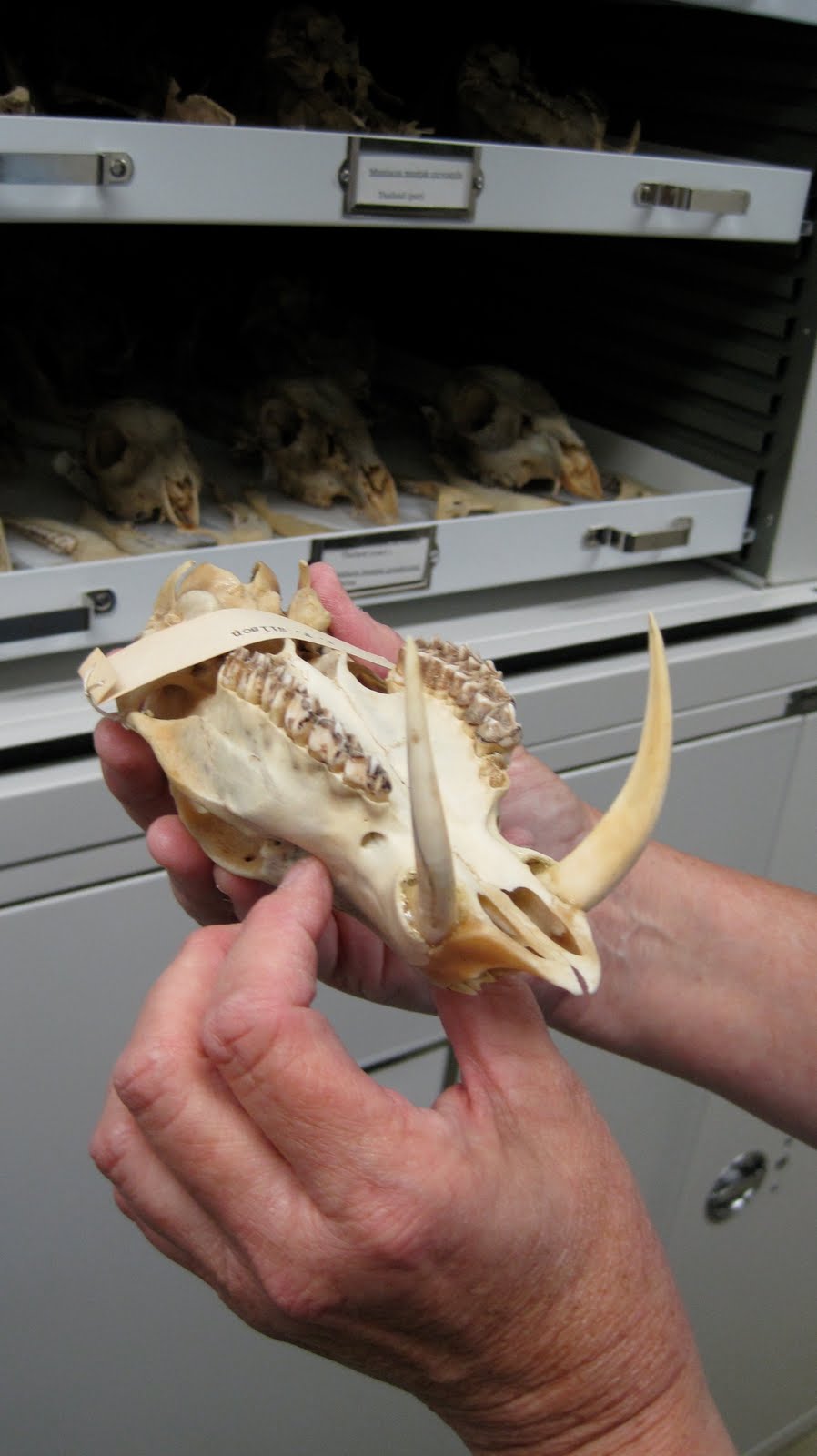
In the Mammal department, I held the rib of a manatee; saw multiple elephant skulls (including that belonging to the elephant in the rotunda); and viewed the pelts of Washington, DC’s two beloved pandas, Ling Ling and Hsing Hsing, who now reside in a drawer at MSC. Apparently many of the National Zoo’s animals eventually end up at the Natural History Museum.

Below: Ling Ling and Hsing Hsing, giraffe skin (note how thick it is), tigers (the one with an open mouth used to be a rug and was then donated), the skull of the elephant in the museum rotunda, the skull of a vampire deer, and a little something from the random reptile shelf in the mammal department.

Monday, July 19, 2010

Week Six: Happy Fourth!


I spent all day on the Fourth of July in the Butterfly Pavilion, and let me just say, what an experience! I rode the escalator up from the Metro to find the streets full of people, every one of whom was covered head to toe in red, white, and blue. By 9 AM the areas around the museum leading to the mall were packed. The national anthem was being sung on the steps of the National Archives.

It was extremely hot, with temperatures hovering in the nineties and up into the hundreds. So, naturally, as soon as the museum opened, all of those people on and around the mall who had arrived at 9 AM to wait for the 9 PM fireworks came in to take advantage of the café and air conditioning. It was a busy, busy day in the Butterfly Pavilion. So many children covered in flags and face paint! Early in the day the children were bouncing around like crazy; I almost lost my voice telling them to stop petting the butterflies. By afternoon, the crowd was more subdued. These were folks who had been outside all morning; some of the excitement had given way to exhaustion. At 6 PM I left the pavilion and changed my clothes.


By 6:30, I was walking into the American History Museum to meet my grandparents. That museum had been closed to the public for the day in order to prepare for the evening’s festivities. Two areas had been set up for the Smithsonian’s three hundred Fourth of July guests. On the second floor, the Apollo Theater and First Ladies’ Gowns exhibits were left open. In the hallway between them was a catered meal of time-honored American summer fare that included hot dogs (in hot dog stands,) popcorn, soft pretzels, and a multitude of desserts. On the roof, (Yep, the roof!) there was more food—from hamburgers, corn-on-the-cob and baked beans to cotton candy. There were games, face painting, and balloon animals for the kids, and battery powered, blinking red, white and blue star necklaces for everyone. The Smithsonian’s guests had an incredible view of the mall, with some of the best seats in town for Washington DC’s spectacular fireworks. It was a very special Fourth.


Week Five: Volunteer Training


Insect Zoo:

Lately I’ve been able to get a really good start on my independent project. I’m creating an online training for volunteers who do tarantula feedings. It involves creating an outline of what should be included in a feeding, basic logistics, instructional videos, surveys, and a general fact sheet with information about tarantulas.

This week I sent out the initial survey to volunteers about how their tarantula feedings work now. Prior to this there has been no official training for doing tarantula feedings, and that was reflected in the survey results. The volunteers are wonderful and give excellent presentations, but there is a wide range, between individual volunteers of material presented and knowledge of tarantula behavior. There are also discrepancies in the length of presentations, which isn’t good. Most volunteers listed their feedings as lasting between 20 and 30 minutes. The museum states that feedings should last no more than 10 minutes.

With this information in hand, I was able to create an outline of what information should be included in a feeding and the logistics of the presentation. I then put this onto a website, with a separate page for tarantula information (which I will be putting together next) and some instructional videos.

Forensic Anthropology Lab:

I have had a few interesting encounters in the Forensic Anthropology Lab this week. In the Insect Zoo people come to see the bugs, usually as a novelty. They come and take their picture with a Madagascar Hissing Cockroach to put up on Facebook, but they don’t always show a great deal of interest in the insects. In the Forensic Lab, in part due to the popularity of the subject on television, visitors are much more engaged in the material. They ask questions and try to solve the case that’s laid out. They still occasionally just want to take pictures with the bones, but not as often.

Visitors also share more harrowing personal stories in the Forensic Lab. In the Insect Zoo I hear people complain about the tomato hornworms in their gardens and ask me how to get rid of them. In the Forensic Lab, one woman told me all about a car accident that fractured her leg and asked what her bones would look like because of that. Another told me about a healed fracture that had never been set properly, again asking what it would look like. Yet another asked about how her cancer would affect her skeleton. One day a man came up to me and confessed the trouble he was having reconciling his faith with the science he was seeing in the museum. He told me about things he’d seen in a creationist museum in Texas. I prepared to deliver the standard “Sir, the Smithsonian is an institution devoted to science and education, not faith. The information presented in this museum is all based on scientific research.” But he did not continue to attack, criticize, or question me about my beliefs or the information presented in the museum, as I have experienced in the past. Instead, he told me that he was trying to keep an open mind. He told me that he supported his son, a biology major, and that he understood that the science made sense, but he was just having such a hard time reconciling this with what he had been taught all of his life. He was clearly very torn and sad about the entire situation. I wasn’t quite sure what to say to him.

The most difficult interaction I have had thus far was with a thirteen-year-old girl. She was looking at a poster on the wall showing different types of burials. She asked me about them, and was curious about what the dead were wearing. We talked for a while and I explained that different cultures have lots of different burial practices and traditions. She then paused for a minute and said, “like in the United States, we’re buried in our favorite outfit. Like my best friend was buried in her prom dress.” It’s difficult to know what to say when things like that come up.

Week Four: Bodies in the Basement

This week I was lucky enough to be able to take a tour of the museum’s Mummy Vault with some other interns. The museum’s mummy collection is not very big compared to some of the other collections, and is housed in the basement. An interesting place-- rumor has it that at one time they were planning to turn the basement into a parking garage. They assigned each curator a space before construction began, but before they had a chance to turn the area into parking, the curators had all fenced off the spaces allotted to them and began filling them with stuff. Museum curators just love stuff. Not one of them ever throws anything away. It didn't come as much of a surprise to anyone working in the museum that the garage never happened. The spaces still sit, sectioned off by chicken wire and full of stuff.


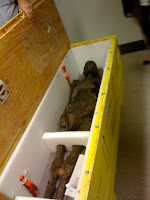
One section of the basement, however, belongs to the mummies. The first things we looked at were a few cast-iron coffins, a couple for adults and one belonging to an infant, with remains yet to be examined. These coffins, when sealed properly, cause natural mummification by keeping air and moisture out. The ones we saw had been found on construction sites in Philadelphia. Apparently old burials regularly turn up at construction sites, and the remains are often sent to the museum. These coffins were all in an area that looked just about the way one would expect the Smithsonian’s basement to look. They lay just inside a dark and dusty chicken wire enclosure, next to some very old (and very politically incorrect) figurines that had been used in early museum displays.

Within the mummy department’s chicken wire cage, there is a room. This room is sealed off from everything else, and inside is a pristine lab. It is temperature controlled, humidity controlled, and spotless. There were a few mummies laid out in the center of the room near some more coffins, and cases lining the walls.


One of the mummies was the “soap man” from Philadelphia. This fascinating mummy began as a man who was buried in a soil that essentially turned all of the fat on his body to soap. There he is, all of the fatty parts of his body preserved forever, still wearing his stockings.


After looking at a couple of the classic Egyptian mummies that sat out next to the soap man, we turned our attention to the cases on the wall. These cases were not long and narrow and did not look like they could hold what we think of as a typical mummy, lying flat with arms across the chest. Instead, one case had drawers full of mummy parts from the days when scientists at the museum would chop up mummies to examine them. (Now, they use medical scanning equipment to examine remains without damaging them.)

One of the dissected mummies was that of an Egyptian girl who had died at the age of sixteen. She was poor, so her organs had not been removed during the mummification process. In her abdomen, scientists found the skeletal remains of a full-term infant; childbirth appears to have been her cause of death. (In picture above the infant remains can be seen in the white box on the lower right side of the shelf).

In another cabinet there was an amazingly well preserved Peruvian mummy. I found her to be the most alarming of the bunch. The woman is seated, with her legs crossed and her hands clasped together supporting her head, which looks as though it is gently resting upon them for a nap. She still has all of her clothing and some of her hair. Apparently the ancient Peruvians mummified their loved ones and left them in a dry cave for a year. The completely dessicated remains could then be brought out and basically reunited with the family. Essentially, their descendants would sit them by the camp fire to participate with the living in religious ceremonies.

The last things we saw were mummified brains and shrunken heads. They were all fascinating, but the stink that came from those cases was slightly awful. It wasn’t the smell of death, but the smell of whatever had been used to preserve the remains, and it was simply not pleasant.

Top: an unfortunate missionary, Center:mummified brains, Bottom: classic example of a shrunken head

Week Three: Escape!


There are very few animals in the Insect Zoo that make me uncomfortable, but one of them is the Amblypygid. This tailless whip scorpion (see picture above) won’t do any permanent damage, but is quick and has always managed to freak me out. Now, in my defense, I should mention that I have never let anything escape in the Insect Zoo. Until…

One morning this week I was helping with the daily prep before the museum opened. Prep includes checking all public displays for dead animals, cleaning the displays, making sure that food and plants in exhibit cases are fresh, misting the animals, etc. I am not normally responsible for the Amblypygid case, but this week, for the first time in three years at the museum, the job was mine. Terrific. The cases open from the back, so the first thing I did was to check through the glass to make sure that there weren’t any animals on the back wall of the case. It was all good—nobody there. I checked twice because I did not want any surprises. Then I walked around to the back and opened the door—ever so slightly-- to reach in with the mister. And as soon as the door was opened, an Amblypygid jumped off the back wall and onto the floor.

We stared at each other for a moment and then it skittered under the display case. I didn’t quite know what to do. I went to find the intern who normally deals with them. He’d know what to do, right? This must happen all the time. Piece of cake. Only the intern said that he’d never seen that happen before. And he was impressed that I’d managed to lose one. (Sarcasm—just what I needed.) More importantly, he didn’t seem too eager to dive in after it either. So, not yet off the hook after all.

We found a plastic container. I took a deep breath, got down on the ground and peered under the case. There sat the Amblypygid. With all of his legs. Staring at me. I gathered my nerves, reached under the cabinet and threw the container lid over him. He skittered some more but was contained. I carefully slid the lid out from under the case. Then blessedly, the other intern (an entomology major who should be able to handle these things!) scooped him back into the rest of the container using the lid and threw him back into the case. The entire process only took ten minutes. Ten long minutes.

Friday, June 18, 2010

Week 2: “Shake it, baby! Work it!”


Insect Zoo

At the beginning of this week, I was asked to assist the museum photographer in taking reference pictures of the animals in our saltwater tanks. These include four species of shrimp, and five species of crab. My supervisor gave me the list of creatures to be photographed. At nine o’clock on the morning of the shoot, I met with the photographer to see what he needed me to set up. The entire process was remarkably similar to an episode of America’s NextTop Model.

The display tanks the animals are normally kept in are not suitable for photographing, so an alternative set had to be assembled. I took one of our back-up tanks, cleaned the glass thoroughly, filled it with sand and gravel from the lab, and then added some saltwater from the tank in the back room. It soon became apparent that the sand and gravel had not been rinsed properly, as the water in my nice clean tankturned… murky brown. Several rinses and one new batch of saltwater later, I had the tank set and ready to go. The shoot took place in our lab, across the hall from the back room where the saltwater creatures are housed. I had assumed that this would simply involve setting the tank on ourlab bench and snapping a couple of shots. But when I walked into the lab I discovered that a set worthy of Tyra had been constructed, including proper lighting, backdrop, and light blocking equipment.

The photographers took multiple test shots and then asked me to bring in the animals one at a time, starting with the crabs. Which was when I discovered that both the Arrow Crab, and the Sally Light Foot Crab had died the week before, and the Green Emerald Crab appeared to have just been eaten by one of the more aggressive shrimp (said shrimp was given his own display tank later that day to prevent further incident.) Luckily, the Decorator Crab was still alive and well, covered in bits of old food and gravel (the Decorator Crab gets its name from its ability to decorate itself with objects found in its environment).

The animals being photographed were on display-- every time I had to retrieve one, museum visitors could see my hand, and only my hand, reaching into the tank to grab the next model. At least twice this resulted in horrified cries from small children, “Mommy! There’s a hand attacking that shrimp!” Despite the children’s concerns, the Decorator Crab was pulled for his close-up. The shoot lasted for almost an hour, during which time it was my job to prod the little guy with a glass rod in order to encourage him to pose more favorably for the camera. Once an acceptable shot had been obtained, I went to fetch the hermit crab (a particularly snippy and disagreeable model.) When his shoot was finally finished, I brought in the first shrimp-- and found out why the photographer had saved the shrimp for last. What fantastic models! I stood watching in amazement while the Skunk Shrimp, in particular, pranced around the tank from one fabulous pose to another as the photographer cried, “Shake it, baby! Work it!”

Anthropology

This week I also attended the interns’ orientation to the Forensic Anthropology Lab. On Saturday morning, we had a brief, behind-the-scenes osteology class given by one of the museum’s leading Forensic Anthropologists. Six tables were set out, each with a couple of boxes of human bones. We learned that these skeletons were part of the Terry Collection, gathered in the early 20th century by a Dr. Terry, who catalogued the age, gender, ethnicity, medical history, and cause of death of each skeleton. There are about 1,700 skeletons in the collection, and they form the basis for the majority of forensic anthropology standards that we have today. The museum houses over 30,000 complete or partial skeletons.

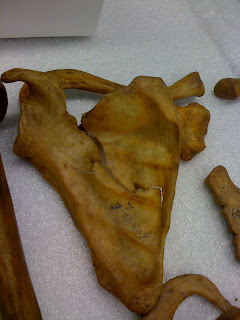
We were each given about 15 minutes to articulate a skeleton as best we could, and then given a basic introduction to osteology. We discussed howto determine age, gender, and ancestry. At the end of the lesson, we were given specific information about our skeletons. Mine was that of a 28-year-old black male, who died in the 1920s or 30s. He had been a book seller and was hit by a train. There was visible trauma to his hip andshoulder blade, and he had multiple broken ribs. On another table there were the bones of a 20-year-old gunshot victim. As sad as these were, one of the most jarring, to me, was the skeleton of an 89-year-old black woman who had died in the 1920s. She had lived through slavery. Her femurs showed that she had broken her hips and they had healed on their own, an undoubtedly long and painful process. There were massive growths that made the bones almost unrecognizable. She also had such severe osteoporosis (hence the broken hips,) that her bones were only half the weight of normal specimens.

At the end of our lesson, we were shown the actual Forensic Lab, the lab behind the scenes (I will be working in the Public Education Lab.) On one side of the U-shaped lab bench, closest to us as we walked in, was a modern case. We were told that the skeleton in frontof us belonged to a 32-year-old mother of three, who had disappeared in 2002after speaking with her estranged husband. Her body was recovered earlier this year and sent to the Smithsonian for examination. The trauma to her spine, neck, and skull was obvious. There was one particularly upsetting puncture in her skull that clearly matched up to a hammer (also in the lab) recovered from the suspect’s home. The Forensic Anthropologist giving us the tour recommended that if we were interested in Forensic Anthropology, we not attempt to do modern casework alone. She reported that she has a great deal of difficulty processing too many of these cases at once, due to the emotional responses they often trigger.

On the bench immediately next tothe 32-year-old murder victim was a skeleton belonging to a young man from colonial Jamestown. It was an amazing thing to see—a working demonstration of the usefulness of forensic techniques in cases from the archaeological to the modern, laid out side by side. I am looking forward to starting in the lab next Friday.
Tuesday, June 8, 2010

Week One: “Baptism by Fire”


For the next ten weeks I will be working in the O.Orkin Insect Zoo, the Butterfly Pavilion, and the Written In Bone exhibit’s forensic lab. My exact schedule has yet to be determined; I am currently bouncing back and forth between the butterflies and insects, depending on where I am most needed on a given day. In my third week I will start in the forensic lab. All of the work I am doing is related to education and exhibit maintenance. My main project for the summer is to create an interactive online orientation for new Insect Zoo volunteers.

I last worked in the museum as a high school intern for the Insect Zoo. It was the summer of 2007, and the Insect Zoo was undergoing renovation and new construction. The exhibit was closed to the public while the new Butterfly Pavilion was being built. At the time, there were two full-time staff, one summer contractor, and me. For a period of months, all the Insect Zoo volunteers were displaced with their insect cart to a back corner of the museum. Much of my time was spent navigating the construction site, hard hat and all, just in order to provide basic animal care. Now, in 2010, the new zoo is up and running. There are eight permanent staff, three interns, and a new set of volunteers for the Butterfly Pavilion. It is a very different place.

On my first day, I filled out the necessary paperwork in the intern office and then wandered up to the Insect Zoo. I was met by my supervisor, who immediately sat me down and said, “Okay, welcome back. Today’s going to be sort of a baptism by fire. It’s free Tuesday in the Butterfly Pavilion. Here’s your shirt, have fun!”

It was wonderful. I put on my new yellow polo shirt with the butterflies on it (it goes almost to my knees. I could just about wear it as a dress,) and began learning the opening speech for the pavilion, the rules, the animals, and how the place runs now. The next morning I was in at 8:00, wearing old clothes, helping to change out all the plants in the butterfly exhibit before changing into a nicer outfit (relatively speaking) in order to interact with the public. I am loving learning the new dynamics and procedures. One of the things I love the most about the museum is how it is constantly changing. Every time I come back there are new exhibits, new volunteers, and new projects. Never a dull moment in the Smithsonian.